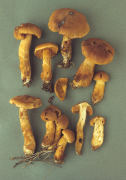
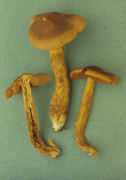
Cortinarius (Cortinarius) Rubellus Cooke, Syn. Cortinarius speciosissimus Kühn. & Romagn.
Prächtiger Schleierling Cortinaire mortel Deadly Webcap Cap 2.5–8cm across, convex to conico-convex then expanded and umbonate, tawny to tawny-date, margin paler, covered in fine adpressed fibrous scales, disc soon smooth. Stem 50–110 x 5–15mm (20mm at base), slightly thickened at base or bulbous, silky fibrous, concolorous with cap or paler, lower part covered in yellow patches of velar remnants. Flesh pale yellowish tinged tawny below cap cuticle and towards stem base. Taste not distinctive, smell slight, faintly of radish. Gills pale ochre at first becoming tawny to deep rust. Spore print rust. Spores broadly elliptic to subglobose, rough, 9–12 x 6.5–8.5µ. Habitat damp conifer woods, often in moss. Season autumn. Rare. Deadly poisonous. Found In Europe. Some mycologist separate C. speciosissimus from C. rubellus.
In 1979 three people camping in the north of Scotland included specimens of C. speciosissimus in a dish in mistake for the edible Chanterelle. Nearly two weeks later they were admitted to hospital with severe renal failure caused by the orellanin complex of toxins present in C. speciosissimus. As is common in cases of orellanin poisoning, one of the three recovered while the others suffered irreparable damage to their kidneys and had to be kept on dialysis treatment until suitable kidney donors could be found. In the last few years C. speciosissimus has been responsible for many deaths in Central Europe. Although it has only recently been recorded from Britain, it may previously have been overlooked.
I enclude C. orellanus here, as I have no picture of it to date.
Cortinarius orellanus
Orangefuchsiger Schleierling Cortinaire des montagnes, Cortinaire couleur de roucou Fool's Webcap Cortinarius (Cortinarius) orellanus Fr. Cap 3–7cm across, convex then expanded and broadly umbonate, tawny-ochre darkening with age, covered in fine downy scales. Stem 30–90´4–12mm, apex yellow, tawny below darkening towards the tapering base. Flesh yellowish-tawny, sometimes reddish in cap. Smell strongly of radish. Gills ochre at first then tawny, finally tinged rust. Spore print rust. Spores elliptic, 9–12´5–7m. Habitat deciduous woods. Season autumn. Rare. Deadly poisonous Distribution, America and Europe. |